
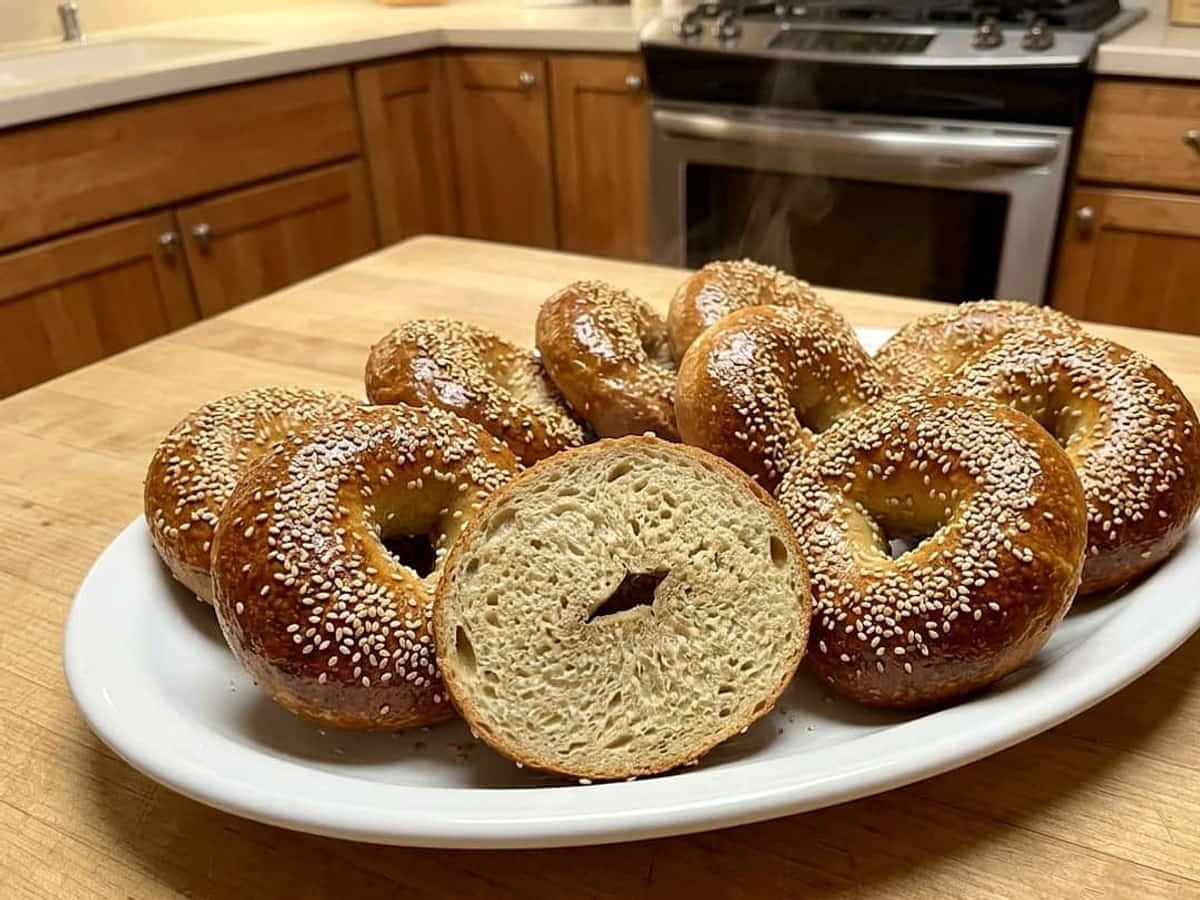
Chewy Homemade Bagels
A bag of flour, a packet of yeast, and a pot of boiling water. That’s genuinely all it took the first time I made homemade bagels from scratch, and I stood at my stove staring at the pot like I’d been lied to my whole life about how complicated this was.
The dough comes together fast, and there’s no kneading. A few stretch-and-folds during the rise does the work instead.
The boil is the moment that surprised me most. Thirty seconds in hot water and those pale dough rings come out looking almost finished, tight and glossy.
The oven does the rest.
My kids eat these faster than I can cool them down. I’ve stopped buying the store kind entirely.
Prep: 25 minutes · Cook: 20 minutes · Total: about 2 hours 15 minutes (with rise time) · Serves: 12 bagels
How do you make homemade bagels chewy?
The chew in homemade bagels comes from two things: a lower-hydration dough (around 64 to 67% water to flour) and a quick boil before baking. The boil sets the outer starch layer so it stays tight and thin in the oven, which is what gives you that dense, chewy bite instead of a soft bread crust.
The Method, in Plain English
- Keeping the dough at 64 to 67% hydration (water to flour by weight) gives you a stiff enough dough to hold its ring shape through boiling and baking, which a wetter dough simply won’t do.
- The brief boil, 30 seconds to 1 minute total according to Emma’s Goodies, gelatinizes the outer starch before the bagels hit the oven. That thin, set shell is what keeps the crust chewy and tight rather than puffing into an open bread crumb.
- Baking at 430°F after the boil drives off surface moisture fast and sets the crust hard, which is what gives you that signature snap when you slice through one.
The first time I skipped the boil on a test batch just to see what would happen. They baked up like dinner rolls.
Good rolls, but not bagels. Don’t skip it.
Why I Keep Coming Back to This One
- No kneading required, just a few stretch-and-folds while the dough rises
- Made with regular all-purpose flour, nothing special to track down
- Freezer-friendly, so you can make a full batch of 12 and have bagels for weeks
- The whole process fits inside a weekend morning without taking over your whole day
What You’ll Need
- 5¼ cups (750 g) all-purpose flour, plus more for dusting
- 2 cups (480 g) warm water (about 110°F)
- ¼ cup (50 g) granulated sugar
- 2 tsp (7 g) active dry yeast
- 2 tsp salt
- 2 tbsp olive oil
- Large pot of water, filled about halfway
- 1 tbsp sugar or honey (optional, helps color)
- 1 egg white, loosened with a splash of water
- Sesame seeds, everything bagel seasoning, or poppy seeds (your call)
A Few Notes on the Ingredients
All-purpose flour is the right call here, and you don’t need bread flour. The lower protein content of all-purpose still gives you plenty of chew once the dough is boiled, and it’s what you’ve already got in your pantry.
Bread flour makes a slightly tougher bagel that can feel more like a workout to eat.
Your yeast needs to be active. Proof it in the warm water with a pinch of the sugar before you mix the dough.
If it doesn’t foam up and smell yeasty after about 5 minutes, it’s dead and your bagels won’t rise. Warm water around 110°F is the sweet spot.
Hotter than 120°F kills the yeast.
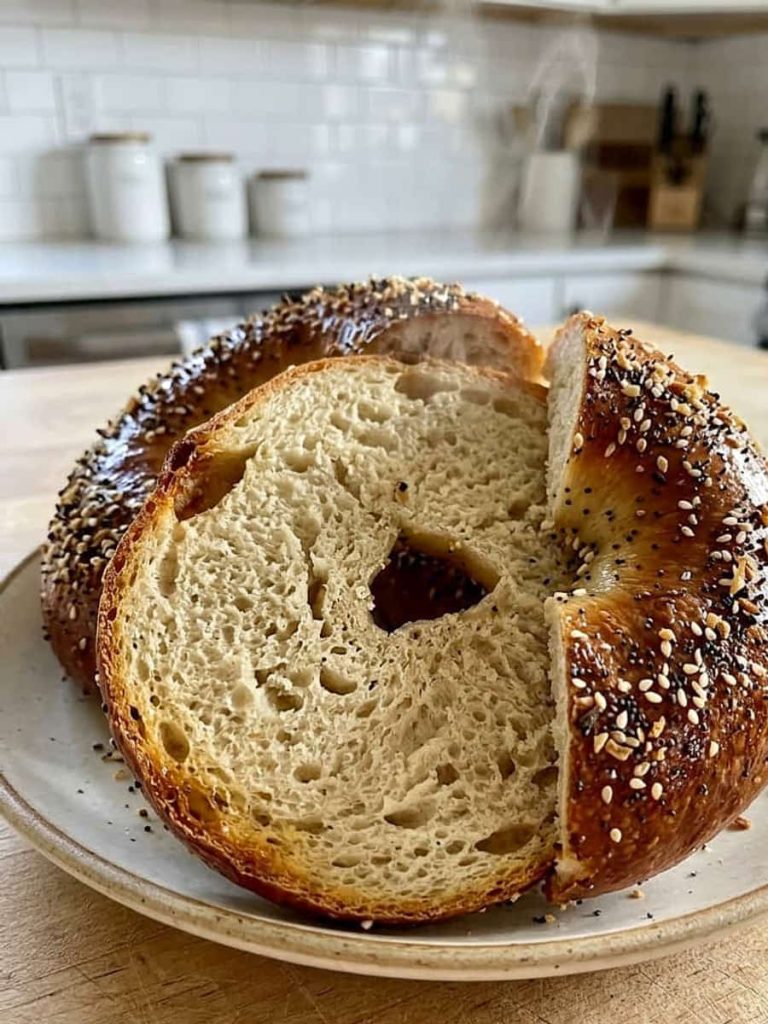
The egg white wash is what makes the seeds stick and gives the tops that shiny, bakery-style finish. I’ve tried skipping it when I was in a hurry, and the seeds just fall off in the oven.
It’s worth the extra 30 seconds.
Step-by-Step Directions
- Proof the yeast. Stir the yeast and a pinch of the sugar into the warm water in a large bowl and let it sit for 5 to 7 minutes, until it looks foamy and smells like bread. If nothing happens after 8 minutes, your yeast is not active and you’ll need a fresh packet before going further.
- Mix the dough. Add the remaining sugar, salt, and olive oil to the yeast mixture and stir to combine. Add the flour in two additions, mixing with a sturdy spoon or your hands until a shaggy, stiff dough forms with no dry flour left in the bottom of the bowl. It will feel much stiffer than a bread dough. That’s correct.
- Let it rise with stretch-and-folds. Cover the bowl with a clean kitchen towel and let the dough rest at room temperature. Every 20 minutes for the first hour, wet your hand, grab one side of the dough, stretch it up as far as it will go without tearing, and fold it over the center. Rotate the bowl and repeat on all four sides. After 4 sets of folds, leave the dough to finish rising until it has roughly doubled in size, about 1 to 1½ hours total.
- Divide and shape. Turn the dough out onto a lightly floured surface and divide it into 12 equal pieces, about 100 g each if you have a scale. Roll each piece into a smooth ball, then poke your thumb through the center and gently stretch the hole to about 1½ to 2 inches wide. The hole will shrink during baking, so go wider than you think you need to.
- Preheat and prep the pot. Set your oven to 430°F and line two baking sheets with parchment. Bring a large pot of water to a full rolling boil and add the tablespoon of sugar or honey if using.
- Boil the bagels. Working in batches of 3 or 4 so the pot isn’t crowded, lower the shaped bagels into the boiling water. Boil for 30 seconds to 1 minute total, turning once, until the surface looks tight, slightly puffed, and matte rather than raw. Lift them out with a slotted spoon and set them on the lined baking sheets.
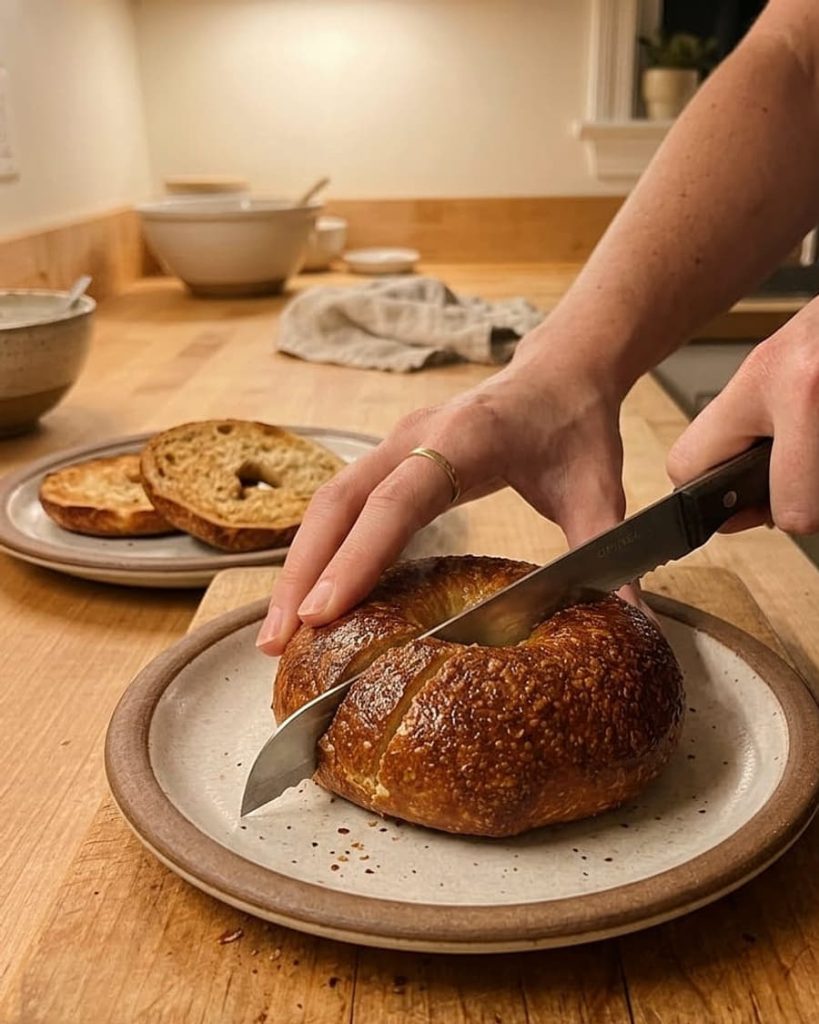
- Top and bake. Brush the top of each boiled bagel with the egg white wash, then sprinkle on your seeds or seasoning. Bake at 430°F for 16 to 20 minutes, until the tops are deep golden brown and the bottoms sound hollow when you tap them. Let them cool on a wire rack for at least 10 minutes before slicing, or the inside will be gummy.
Tips From My Kitchen
- Don’t rush the rise. If your kitchen is cold, the dough may need closer to 2 hours to double. A slow rise builds more flavor, so there’s no harm in letting it go longer.
- The hole really does shrink. I made the mistake of shaping tight little rings my first few batches and ended up with solid discs. Stretch the hole to at least 1½ inches, ideally 2.
- You can shape the bagels the night before, refrigerate them uncovered on the parchment-lined sheet, and boil and bake them straight from the fridge the next morning. They’ll need an extra minute or two in the boiling water since they’re cold.
- If your bagels come out pale on the bottom, move the rack down one position for the next batch. Every oven runs a little differently at high heat.
- Freeze cooled bagels in a zip-top bag for up to 3 months. Slice them before freezing so you can toast them straight from frozen.
Storage and Make-Ahead
Homemade bagels don’t have the preservatives that keep store-bought ones soft for a week. At room temperature in a paper bag or bread box, they’re best within 2 days.
After that, the texture gets tough rather than chewy. For longer storage, the freezer is your best option.
Slice each bagel before freezing, lay the halves flat in a zip-top bag, and freeze for up to 3 months. Toast straight from frozen on a medium setting, and they come out tasting fresh.
Don’t refrigerate them. The fridge actually speeds up staling in bread and makes bagels go rubbery faster than leaving them on the counter.
Rounding Out the Meal
- Cream cheese and a thin slice of tomato, because it’s the classic pairing and there’s a reason it stuck around
- Scrambled eggs and a slice of cheddar tucked inside, which turns one bagel into a full breakfast that holds up until lunch
- Peanut butter and sliced banana for the kids, since the chew of a homemade bagel stands up to thick spreads better than a soft sandwich roll
- A bowl of tomato soup alongside a toasted bagel half, which works the same way a grilled cheese does but with more bite
Tools You’ll Need
- A large mixing bowl, wide enough to do stretch-and-folds without dough flying over the sides
- A large pot, at least 6 quarts, so the bagels have room to float and don’t crowd each other during the boil
- A slotted spoon or spider strainer, for lifting boiled bagels out of the water without burning your hands
- Two rimmed baking sheets lined with parchment, so the bottoms don’t stick at 430°F
- A wire cooling rack, because bagels sliced too soon off a solid surface trap steam underneath and go gummy on the bottom
Questions I Get About Homemade Bagels
Can I use instant yeast instead of active dry yeast? Yes, and you can skip the proofing step. Just mix the instant yeast directly into the flour with the other dry ingredients, then add the warm water. Savor Easy’s recipe uses 2 tsp of instant yeast to 3 cups of flour, so the ratio is well established.
Why do bagels need to be boiled before baking? The boil sets the outer layer of starch through a process called gelatinization. It creates a tight, thin shell around the dough that holds its shape in the oven and gives you that chewy crust. Without it, bagels bake up like regular rolls.
Can I make the dough ahead of time? You can do the bulk rise in the fridge overnight instead of on the counter. Mix the dough, cover the bowl tightly, and refrigerate it for 8 to 12 hours. Shape, boil, and bake the next morning. The cold rise actually improves the flavor.
Why did my bagels lose their hole? The hole closes up if it’s shaped too small to begin with. Stretch it to at least 1½ to 2 inches wide before boiling. The dough puffs during the boil and bake, so what looks like a generous hole at shaping becomes a small one by the time the bagel is done.
Do homemade bagels freeze well? They freeze very well for up to 3 months. Slice them before freezing so you can go straight from the freezer to the toaster without waiting for them to thaw.
Keep Cooking
- Chewy Snickerdoodles
- Classic Apple Crisp
- Classic Apple Pie
- Classic Baked Ziti
- Classic Beef Chili
- Classic Beef Stew
- Classic Blueberry Muffins
- Classic Carrot Cake with Cream Cheese Frosting
- Classic Chocolate Cake
- Classic Cornbread
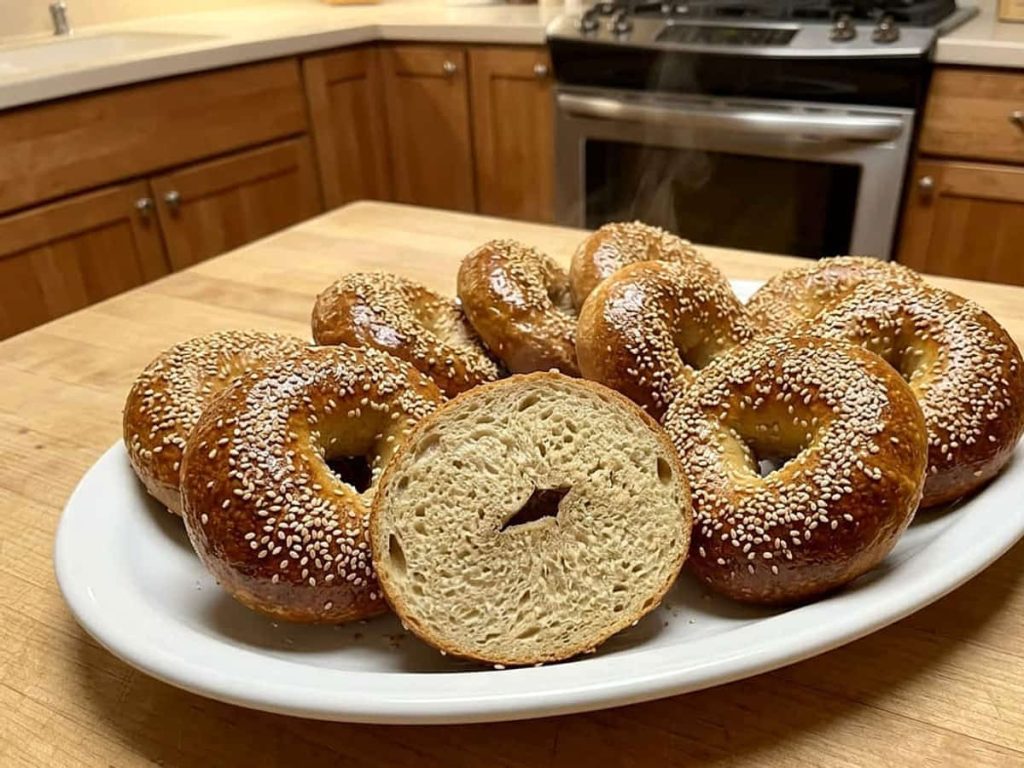
Chewy Homemade Bagels
Course: BreadCuisine: American12
servings25
minutes20
minutesIngredients
5¼ cups (750 g) all-purpose flour, plus more for dusting
2 cups (480 g) warm water (about 110°F)
¼ cup (50 g) granulated sugar
2 tsp (7 g) active dry yeast
2 tsp salt
2 tbsp olive oil
Large pot of water, filled about halfway
1 tbsp sugar or honey (optional, helps color)
1 egg white, loosened with a splash of water
Sesame seeds, everything bagel seasoning, or poppy seeds (your call)
Directions
- Proof the yeast. Stir the yeast and a pinch of the sugar into the warm water in a large bowl and let it sit for 5 to 7 minutes, until it looks foamy and smells like bread. If nothing happens after 8 minutes, your yeast is not active and you’ll need a fresh packet before going further.
- Mix the dough. Add the remaining sugar, salt, and olive oil to the yeast mixture and stir to combine. Add the flour in two additions, mixing with a sturdy spoon or your hands until a shaggy, stiff dough forms with no dry flour left in the bottom of the bowl. It will feel much stiffer than a bread dough. That’s correct.
- Let it rise with stretch-and-folds. Cover the bowl with a clean kitchen towel and let the dough rest at room temperature. Every 20 minutes for the first hour, wet your hand, grab one side of the dough, stretch it up as far as it will go without tearing, and fold it over the center. Rotate the bowl and repeat on all four sides. After 4 sets of folds, leave the dough to finish rising until it has roughly doubled in size, about 1 to 1½ hours total.
- Divide and shape. Turn the dough out onto a lightly floured surface and divide it into 12 equal pieces, about 100 g each if you have a scale. Roll each piece into a smooth ball, then poke your thumb through the center and gently stretch the hole to about 1½ to 2 inches wide. The hole will shrink during baking, so go wider than you think you need to.
- Preheat and prep the pot. Set your oven to 430°F and line two baking sheets with parchment. Bring a large pot of water to a full rolling boil and add the tablespoon of sugar or honey if using.
- Boil the bagels. Working in batches of 3 or 4 so the pot isn’t crowded, lower the shaped bagels into the boiling water. Boil for 30 seconds to 1 minute total, turning once, until the surface looks tight, slightly puffed, and matte rather than raw. Lift them out with a slotted spoon and set them on the lined baking sheets.
- Top and bake. Brush the top of each boiled bagel with the egg white wash, then sprinkle on your seeds or seasoning. Bake at 430°F for 16 to 20 minutes, until the tops are deep golden brown and the bottoms sound hollow when you tap them. Let them cool on a wire rack for at least 10 minutes before slicing, or the inside will be gummy.
